Entity Clarity: What AI Models Expect from Your Shop
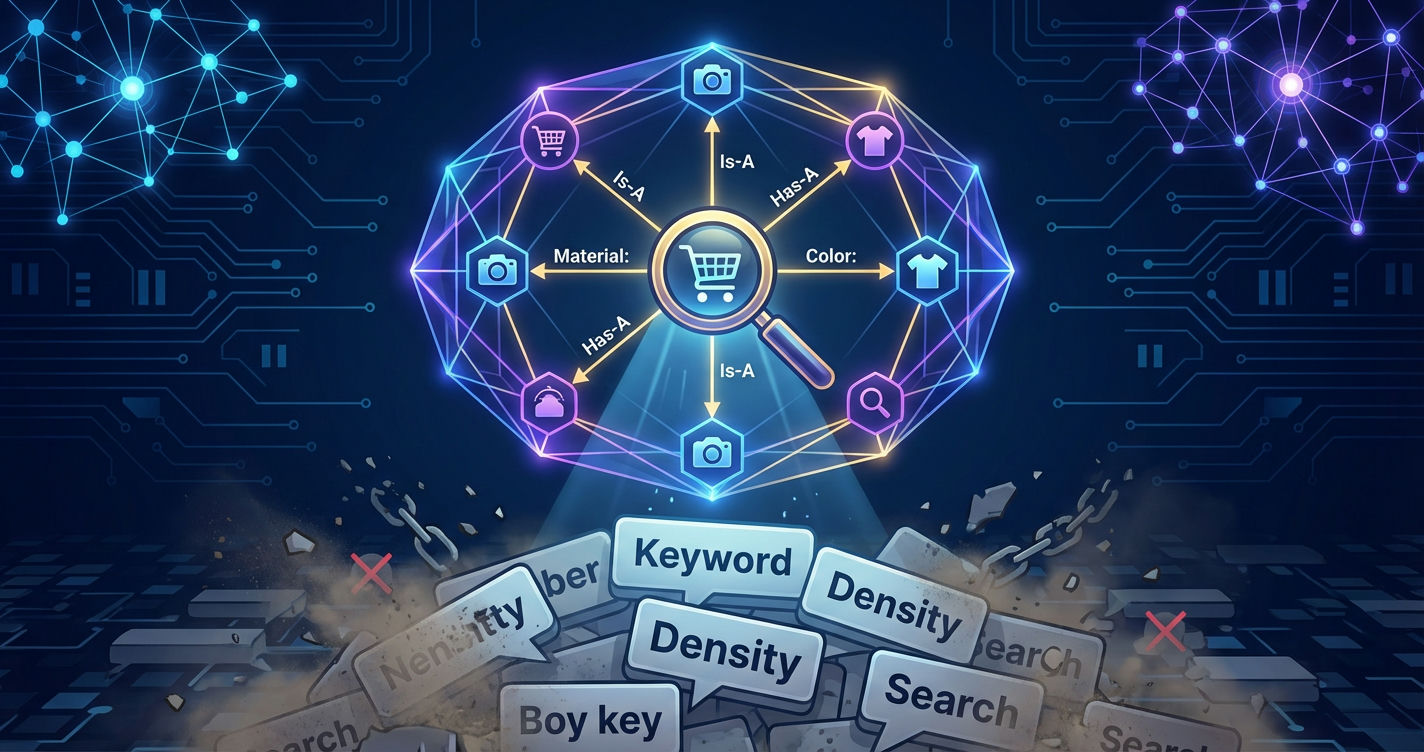
Entity Clarity instead of Keyword Density: What AI Models Really Expect from Your Shop
The era of classic search engine marketing, where ranking was primarily determined by the mathematical ratio of keywords (keyword density) and the sheer number of backlinks, is coming to an end. With the rapid advent of Large Language Models (LLMs), the currency of visibility has shifted.
Today, the decisive criterion is no longer: "How often does the term appear on the page?", but rather: "Are the entities clearly identified and is the information verified trustworthy?".
From Keyword Volume to the Entity Paradigm
AI models are looking for "Entity Clarity" and "Verified Trust". An LLM does not read text as a mere string of characters, but tries to map the concepts contained in the text. An entity is a uniquely identifiable object – a person, a brand, a specific product or a location.
Classic SEO asked: How often does "buy running shoes" appear? AI asks: Is "Pro-Run" uniquely identifiable as a brand? Does an entry exist in a Knowledge Graph? Do the product data match external sources?
When an AI search engine like Perplexity or ChatGPT makes a recommendation, it gathers information from various sources. Shops whose entities are clearly defined are preferentially cited — not because they have more keywords, but because the AI can classify them as reliable sources of information.
AI doesn't just rank you on a list – it trusts you, or it doesn't.
Entity Recognition: How AI Understands Your Brand Identity
The central driver for Entity Clarity is the implementation of Schema Markups (Structured Data). Through Schema data, you speak directly the language of the AI's databases.
Without structured data, an LLM has to analyze the entire page text and try to extract entities itself — an error-prone process. With correct Schema.org markup, however, you provide the AI with the entities on a silver platter: name, type, relationships, and attributes are clearly encoded.
A concrete example: If your shop is called "Naturkosmetik Müller", but the website only says "Welcome to us", the AI has a problem. With an Organization schema including name, url, logo, and sameAs links to your social media profiles, however, the AI can immediately classify your brand.
The Knowledge Graph: Thinking in Relationships
Artificial intelligence visualizes information in a Knowledge Graph — a network of entities and their relationships to each other. Typical relationships:
- related_to: Which subject areas are linked to your brand?
- belongs_to: To which superordinate business category does your shop belong?
- includes: Which specific features does your offer include?
- manufactured_by: Who manufactures the products?
- certified_by: Which certifications or seals of approval confirm the quality?
Strategic Prioritization of Schema Types
Organization: The Basis of Brand Identity
The homepage should absolutely be marked with the Organization type. This defines your brand as an independent entity in the Knowledge Graph. Mandatory fields:name, url, logo, contactPoint, and sameAs (links to Wikipedia, LinkedIn, social media).
Person: E-E-A-T through Author Entities
Author pages should use the Person type for Experience, Expertise, Authoritativeness, and Trustworthiness. Especially for blog content and guides, it is crucial that the AI can classify the author as an expert.Product: Visibility in the AI Shopping World
In e-commerce, the Product schema is essential. Only with complete product data (name, SKU, GTIN, price, availability, reviews) can your product appear in AI-generated recommendations.Article & FAQPage: Direct Answer Extraction
FAQPage serves as a source for direct answer extraction. If a user asks a question that exactly matches one of your FAQ entries, the likelihood of a direct citation increases significantly.HowTo: Step-by-Step Extraction
Instructions in HowTo format allow the AI to play out complex processes as helpful snippets. Each step is individually indexed and can serve as an independent answer.Crucial Entity Properties for Maximum Trust
- sameAs: Links your entity to other authoritative profiles (Wikipedia, social media). This is one of the strongest trust signals for AI models, as it allows external validation.
- about & mentions: Define what the core is about and which entities are referenced. This helps the AI to better understand the thematic context.
- author & publisher: Establish the connection between content and the responsible entity. Without these properties, the content floats contextlessly in the digital space.
- dateModified: Signals to the AI that the information is still relevant. Outdated content is systematically devalued.
- hasOfferCatalog: Links your organization to the product offering and creates a direct bridge between brand and assortment.
Practical Checklist for Entity Clarity
- ✅ Organization schema on the homepage with
sameAslinks - ✅ Product schema on each product page with GTIN/SKU
- ✅ FAQPage schema on help and information pages
- ✅ Person schema for blog authors and experts
- ✅ Consistent naming across all channels
- ✅ Regular updating of
dateModified
Conclusion: Trust instead of Ranking
AI models don't rank you based on mathematical formulas of the past – they evaluate your credibility and identifiability. Ensure clarity in your structure, verify your identity through external references, and maintain your entities with the same care as your inventory. Entity Clarity is not a one-time task, but an ongoing process — just like the trust you build with it.